
A Vocabulary of Lines: Art as a process for nurturing risk-taking and building social-emotional competencies.
Take a blank sheet of paper and try drawing something. For many adults, it’s unexpectedly nerve-wracking. What do you draw? Where do you start? Overthinking quickly takes over. A blank page- like a blank day- offers the opportunity decision making. It’s possibility waiting for direction.
Visual arts give children a safe place to practice that choice. They learn to sketch ideas, organise their thoughts, test possibilities, and turn nothing into something. That’s why art can’t be an after thought.
This is why, at Nurture, we strongly advocate for the visual arts. When we give children the opportunity to express their thoughts on a blank page, mould a block of clay, or twist and turn a straight piece of wire, this isn’t just creativity. It’s life training. It’s how children learn to think, decide, take risks, and trust their own ideas.
A child’s artistic expression is not simply a pretty picture for the fridge. Art speaks before words- it is one of the oldest forms of human expression. Art is the language of humanity. If you want to understand what matters to a child- how they feel, what they’re thinking- don’t ask. Look at what they draw.
In contrast to the endless possibilities of a blank page, ready-made templates like colouring books, worksheets, join-the-dots activities, or highly teacher-directed art can send a very limiting message about a child’s capability.
When well-intentioned adults take over and draw for children, we may unintentionally rob them of the opportunities for risk-taking, confidence-building, and the discovery of their own mana and potential.
But this doesn’t mean we stay completely hands-off- hovering nearby and offering only, “Wow, that’s a great picture.” I’ve been guilty of that myself, before learning more intentional ways to support children’s artistic processes.
So, the question here is:
What is the adult’s role in this crucial aspect of a child’s development?
How can we be thoughtfully and moderately involved- gently scaffolding young artist- without taking over?
“Good teaching is forever being on the cutting edge of a child’s competence.”
As Jerome Bruner
Finding the balance between support and struggle is one of the greatest challenges for us as adults. And what helps is gaining a sound perspective of these moments of struggle- as opportunities in disguise- a powerful teacher for both the child and the adult guiding them. Overcoming struggle builds strength. We see this across nature: just as a caterpillar develops powerful wings through the effort of emerging from its cocoon, children develop capability through challenge.
In early childhood, we witness this every day, in every moment. And as responsive adults, our choice to step in or step back can either create dependency or empower children. A deep and lasting understanding grows when children do the thinking themselves.
Just as we wouldn’t climb the monkey bars for a child- because every attempt strengthens their body, mind, and sense of agency- we don’t build their towers for them either. We join alongside, observe, comment, and support, but we don’t take over.
The same is true in creative learning. We don’t draw for children- but we can draw alongside them. The shift happens when we recognize a child’s creative work not as a final product, but as a meaningful process of enquiry, problem-solving, and expression.
At Nurture, we intentionally use the visual arts to foster self-efficacy in our learners. With additional support from our curriculum leader, Jo Clark, our focus on enquiry through visual arts has further deepened. We are now more deliberate in engaging alongside children in their artmaking, guiding exploration while honouring their ideas, choices, and creative processes.
Useful, practical ways to draw alongside a child might include drawing with our less-dominant hand or intentionally drawing as an eleven-year-old might- imperfect, exploratory, and unfinished. These small shifts signal that we are co-learners, not experts taking over.
At times, it may be as simple as making a small mark to help a child begin or slowing down to break down what we see together.
When a child says, “Can you draw a cat for me?” we don’t need to say no- but we don’t need to do it for them either. Instead, we might respond:
“What do you already know about a cat?”
“What shape are its eyes?”
The child can then start confidently by drawing a simple circle- like a warm-up- building momentum from something familiar.
These moments matter. They honour the child’s ideas, reduce fear of getting it wrong, and keep ownership of the work where it belongs: with the child.
Visual Exploration through Chick sketches-
One of the standout moments of 2025, for our tamariki, was welcoming the living eggs into our learning environment. The children were instantly curious- posing questions, observing and expressing their thoughts through the arts. There were spontaneous drawings of eggs in every corner of the room. They were telling us through the language of drawing, ‘I’m interested in this. This matters to me.’
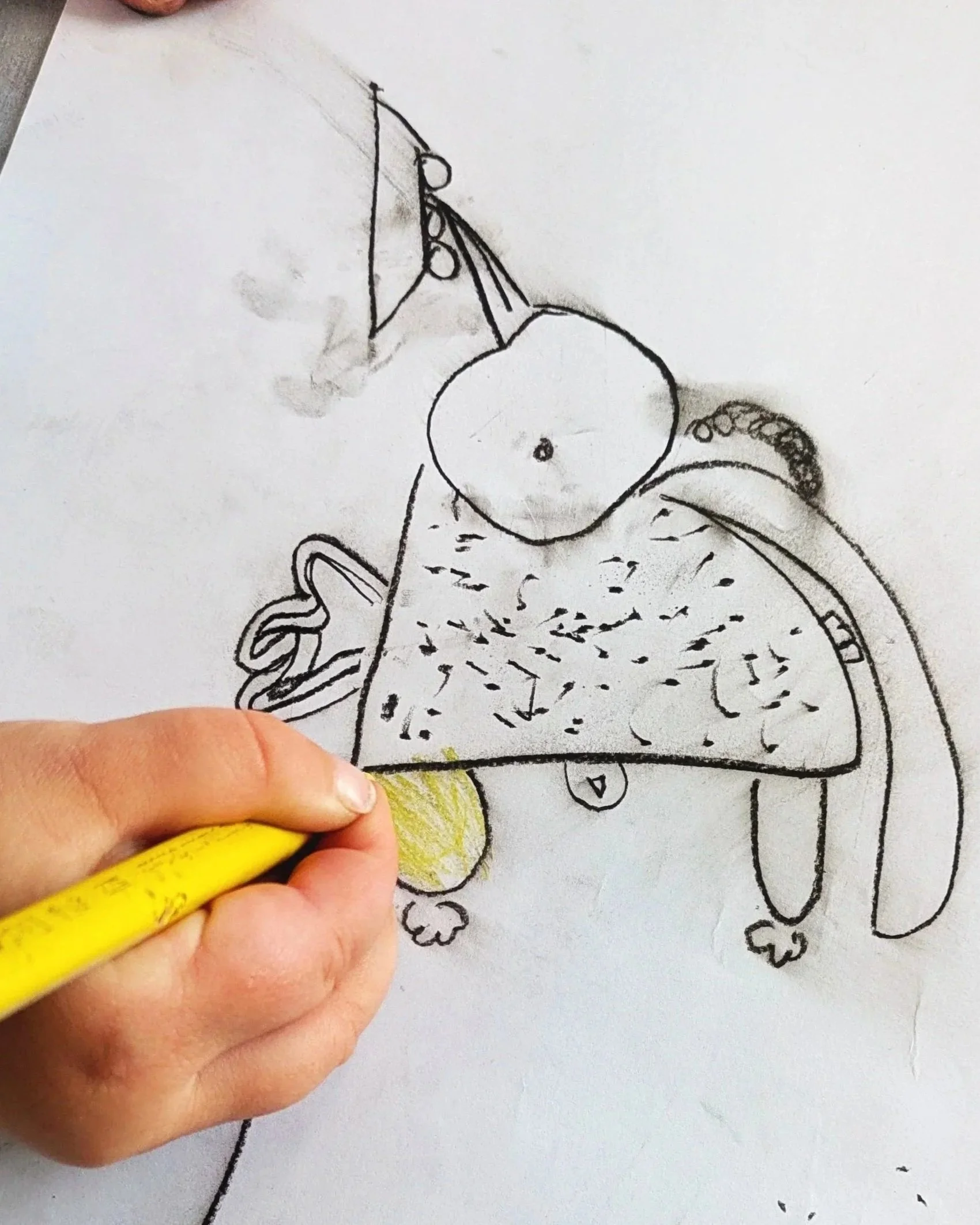
Offer children time…
“I don’t know how to draw a chick,” a child exclaimed, pausing, “but I know how to draw a beak.” And with that, she took off- drawing an entire chick.
Yet, the moment the chicks began to hatch, all the egg drawings disappeared. The children returned to drawing what seemed more within their comfort zone—rainbows and families. When invited to draw the half-hatched chicks, most children responded, “I can’t draw that.” This highlighted a disconnect between their interest and their confidence. It was a moment of struggle- one of those rich learning opportunities we recognise as educators.
It dawned on us that we need a warm-up before engaging in unfamiliar or challenging tasks. Much like as singers warm up their voices or we adults need before an intense Pilates session. This challenging task at hand warranted a warmup too. We introduced our drawing warm up- a rich array of line drawings or what I call deliberate mark making. The language of drawing begins with a vocabulary of lines- simple, deliberate marks that help children make sense of form, movement, and their own ideas. Lines are the building blocks of any shape - vertical, horizontal, zigzag, spiral, thick, thin, broken, wavy. Repeatedly exploring this variety of line-built competence and confidence in our children. We also offered whiteboards or blackboards so marks could easily be erased-thereby reducing the fear of ‘getting it wrong’ and supporting risk-taking.
One day, one of our tamariki discovered form using the vocabulary of lines and announced proudly, “Look! I connected my lines to make this!” This demonstrated to us how skills develop when children are offered time, materials, and gentle scaffolding- without adults taking over.
By now most of our chicks had hatched, and it was time to revisit our challenge of observational drawing. We decided to capture the chicks through our drawings to remember them before they grew up and left Nurture. Black pencils and paper were offered, intentionally keeping colours aside to encourage focus and minimise temptation to draw the familiar rainbows and families. Predictably, the children started with hesitant ovals and requests like “You draw it for me.” But we didn’t. Previously, drawing for them had resulted in homogenised, adult-influenced work- many me too replicas of a cartoonish version of the chicks. We’d learned our lesson- when adults draw, children copy. When adults hold back, children create.
Instead, we scaffolded through narration, modelling alongside- not ahead- and breaking forms into simple lines and shapes, talking about beaks, wings. It gave them time to really see. We can apply the age-old adage here- How do you eat an elephant? One bite at a time. How do you draw an elephant? One line at a time.
The struggle intensified- One of our younger learners with two older siblings, became visibly frustrated and kept saying, “I can’t draw. You have to draw for me.” She was reluctant to put pen to paper and take the risk of starting. By repeatedly breaking the form into simple lines and beginning with just the eyes, she was able to try. When she finished, she wiped her tears and proudly said, “I did it.”
One child began by drawing the chick’s body as a simple ‘smiley face.’ But when encouraged to slow down and observe more closely, she added the beak- a small but significant shift in noticing. Another child wrestled with the difference between a profile view and a front view, practising repeatedly. After deep breaths, visible frustration, and a willingness to persist, she finally tried the suggestion offered by a peer.
As the children slowed down, really looked, and trusted themselves enough to begin, we watched their confidence grow.
“I don’t know how to draw a chick,” a child exclaimed, pausing, “but I know how to draw a beak.” And with that, she took off- drawing an entire chick.
It was likely the familiar zigzag line of the beak we had been practicing that gave her a place to start. A small, known step that unlocked something bigger.
It was an authentic moment of agency- one that energized the entire group and reminded us what happens when children are given time, tools, and trust.
The resulting drawings were diverse, expressive, and deeply individual. No replicas. No ‘me-toos.’ A powerful reminder that when we step back from being the expert, children step forward as creators. By noticing what each child could already do and offering a gentle stretch just beyond their comfort zone, we supported real, meaningful progress. Encouraging them to look closely and ask questions led to noticeable changes- for example, a simple smiley face transformed into a beak. One child persevered, drawing the chick in profile instead of front-on.
Collaborating in a tuakana–teina group helped children navigate challenges, learn from one another, and build trust as a cohesive community of learners. Recognising the value of visual arts enquiry in our centre, we appointed a dedicated artist to work with our 3–5-year-old learning environment once a week. This initiative has had a profoundly positive impact, nurturing the children’s curiosity and enthusiasm for exploring and expressing themselves through a range of visual media.
Even seemingly simple struggles in art hold profound lessons for life. By breaking tasks into manageable steps, children learn to move beyond perfectionism, take risks, and engage both mind and body. They also experience the strength of collaboration—learning alongside and from one another. These are not only early childhood skills but lifelong lessons. I know this personally, having once been that child—reluctant, perfection-focused, and needing support to take the first small step rather than having an adult do it for me.
By Guneet Sachdev, Centre Manager, Nurture Early Learning Onehunga.